Last week I experienced my first ever tropical holiday. I’d
only ever seen the postcards of stunning sandy panoramas; posters featuring lone wooden boats marooned in paradise with the caption "Dream"; Getaway
episodes where the presenter gracefully swims through an outrageously large swimming
pool; and of course the movie Castaway where Tom Hanks is planewrecked on an island
somewhere near the Cook Islands in the South Pacific - which happens to be the
location of said tropical holiday.
The chance to spend a week in the sunny paradise of the
Cook Islands for a friend's wedding (after only venturing to the frost bitten,
grey lands of Europe) was one I jumped at right away. What do I pack? Will it
be hot? What food do they eat? What shopping do they have? Were all questions
that ran through my mind before we left. I was awash with excitement and eager
to escape the hectic world of work to relax on the beach, cocktail in hand and
do nothing. We jetted off with suitcases packed full of sunscreen,
swimmers and summer dresses, and besides two bouts of my annoying car sickness
on the way to the airport, the 6-hour plane flight to Rarotonga, the main
island, went off without a hitch.
 |
| Rarotonga airport |
The Cook Islands are on the other side of the International
Date Line which means we gained an extra day and were feeling a tad groggy on
our first day. We‘d left Sydney at 9pm and arrived in Rarotonga at 7am the day
before (meaning it was really 3am Sydney time).
The whoosh of hot humid air as soon as we stepped off the plane onto the
tarmac sure woke us up. Compared to the miserable cold rainy weather we’d been
experiencing back home our odds for a warm tropical holiday were looking good!
A representative from our resort
The Rarotongan Resort and Spa greeted us with a freshly-made pungent flower "ei" necklace and
packed us away on a shuttle bus where we saw our first glimpses of the
island.
Rarotonga is the biggest and main commercial hub of the Cook
islands. There are 12 islands all up and I had envisaged ferries tripping to
and from them all. But the islands are actually very far away from each
other - The second largest island Aitutaki is a 45 minute plane flight away and
the other islands such as Puka Puka (where the natives speak a language even
the Cook Island Maoris cannot understand) are a 5-6 day boat trip. Indeed you
get the sense that locals here consider themselves to be more Rarotongans than
Cook Islanders and most souvenirs are emblazoned with Rarotonga.
 |
| A typical Rarotongan home |
There is one main road around the island with an inner “Old road”
running parallel closer to the foot of the looming jagged peaks of the inland rain forest-covered mountains. Between the mountains
and the sea is where the islanders live in shabby asbestos beach shacks kept company by coconut palms, hibiscus trees and frangipanis. Most islanders use
scooters/mopeds to get around which is a smart idea considering fuel is $2.65 a
litre. There are cars but none are new and are not exactly the latest Ford or
Toyota models available to us here. You get a sense that they are primitive but
only because they are so far away from the rest of the world. Just about
everything is imported from New Zealand as the main industry here is tourism (and also black pearls and crafts such as weaving and wood carving).
 |
Tangaroa - God of the
sea and fertility! |
|
| | | | | |
|
|
The second thing you’ll notice (after noticing first that coconut palms are in no short supply here) is that Cook Islanders treat
their dead very differently. A common site are graves situated in the front
yards of many houses. Their reasoning behind this is that instead of sticking
dead family members in a cemetery where they are visited once in a blue moon,
why not bury them near the house so they’ll always see them and be reminded of
them? It makes sense but it's still abit creepy and what if you wanted to sell
your house? Indeed we spotted no real estates on Rarotonga.
At the resort we were instantly greeted by a giant wooden
carved statue with a rather, er, large appendage. We were soon to find these
are a very common occurrence around the island, both in gift shops and as decor.
His name is Tangaroa and he is the god of the sea and of fertility (go figure).
 |
| Just another day in paradise |
The day we arrived was an overcast day so when we rushed out
to the resort’s beach to see the postcard of magical turquoise water and soft
white sand for ourselves we were a tad disappointed. Without the sun this
paradise is dulled. But with sun it's instantly transformed. The water turns a
vibrant turquoise colour, the sand glows with the suns rays and the fish glide
and scatter beneath the surface. A reef surrounds most of the island about ½ a
kilometre out from the beach with the distant waves crashing against a
constant soundtrack.
The sand here is very different to Australia's. Not only
is it white (not yellow) it's very course, not smooth, and when you look closely
it is actually crushed up dried coral. Lush tropical trees are throughout the
resort, and of course the ever present coconut palms. The smell of
frangipanis and beautiful Tiare Maori gardenias waft around with
red hibiscus, orange birds of paradise and potted pink moth orchids making
appearances. It's little wonder everything is so green and lush as short tropical showers in the afternoon and storms at night are
frequent.
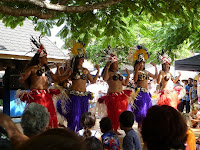 |
| Cook Island dancers at Punanga Nui markets |
Going to the Punanga Nui markets after we'd checked in was a
nice chance to experience the island culture. We caught the island's shuttle bus
back into the main town, Avarua, the main “CBD”. Hopping out of the bus we were
instantly blasted with Celine Dion's "A New Day Has Come" from giant black
speakers at the entrance, a funny song to welcome tourists! Browsing the market stalls there were many
souvenirs: braided wrist bracelets and anklets, shell necklaces, coconut bras,
sarongs, fish and whale statues made out of coconuts, woven hats, grass skirts,
wooden statues, etc. But after 5 or 6 stalls the souvenirs seemed to repeat
themselves and we were beginning to get a taste of the expensiveness of the
island. A key ring = $9.50, fridge magnet = $12, wooden Tangaroa statue = $35+,
a return shuttle bus ticket no matter what the distance = $7. My plans for
stocking up on souvies were quickly quashed!
 |
| The mountainous inland |
The expensiveness must be because of their isolation as the
Cook Islanders are a relaxed bunch. They live on “island time” meaning service
can be a bit slow and things are always done in a calm, relaxed manner. This
also applies to road rules; drink driving and other road infringements we
wouldn’t dare commit here happen all the time. Riding in the back of utes, holding small babies
in our laps, etc is just how it’s done and no one bats an eyelid. The
island has only one breathalyzer - which they never use - and only got two
years ago. Although they have fairly relaxed rules there are not many accidents and the
ones that do happen are usually tourists. You get a sense that the islanders
have a love/hate relationship with tourists. While tourism is the island's main
industry I can see how tourists can become a bit of nuisance. The islanders who
worked at the resort were nice but you just got a sense that they were smiling
and saying hello not because they wanted to but because they had to.
 |
| Delicious cocktails! |
Cook Island food was a tad hit and miss. I tried to stick to seafood as mainly
everything else has to be imported from New Zealand. The restaurant at the
resort, Captain Andy's Bar and Grill was average food for a high price. The
restaurant next door called The Sanctuary in the adults only accommodation was
much better. Our continental breakfast every morning consisted of fruit, toast,
cereal and pastries. Lunch and dinner menu items were pretty much what we have
back home: your usual Reef and Beef, Salt and Pepper Squid, Lasagne, burgers,
etc. But the seafood I had was fantastic, Yellow fin tuna steaks at Whatever Bar
and Wahu fillets at Kikau Hut were delicious. I'd definitely recommend Kikau
Hut as the service was fantastic - the waitress wrote down all our names (we
were a table of 11) and addressed us by name every time we wanted a refill. It
was also a good opportunity for some souvenir shopping as they sold reasonably
priced branded stubby holders and beer and wine glasses.
 |
| Rarotonga's Christian Church |
On Sunday I did what most Cook Islanders do and went to
church. The church was a crisp white building with it’s front yard crammed with
graves. Me and a few other tourists entered the building where we were ushered
to a pew roughly in the middle and I was given a quick warning not to drink from my
water bottle in the church and to go outside if I needed to. The church
quickly filled up with Cook Islanders and some more straggling tourists. The
front empty cues were soon filled with young chattering children and the rows
either side of us filled up with locals. The women were all dressed up with
elaborate straw woven hats and their best tropical printed Sunday dresses. The
church dias was scattered with pink potted orchids and large doilies whereby
the pastor stood, a tall man who somehow reminded me of my old school
principle. The service consisted of an address by the pastor, some bantering from the locals and lots of singing. Most of the
service was spoken in Maori but the pastor was kind to welcome us tourists and
to invite us back for coffee and tea at the neighbouring building. The singing
was incredible, the women sung and the men harmonised beautifully with them. There was a real sense of community in the church and you got a real sense of the Cook Islander's joyful spirit.
 |
| Horse riding in the lagoon |
For the rest of the week we swam, snorkeled, ate, sun baked,
lounged by the pool, read a book, hired bicycles, kayaked, went for a horse
ride on the beach and through the lagoon, drank cocktails, went out for dinner,
saw a fire show, had a massage, got a manicure, napped, saw a hula dance show,
went for a scooter ride and swam in the resort’s pool bar. Being in a large
group was really fun, especially at night when we’d all have dinner together
then have drinks afterwards by the pool or on the deck. It felt like being on
school camp! The resort was well organised and every day they had an itinerary
of activities, some of these included crab races, night snorkeling,
Maori lessons, weaving lessons, fish feeding, snorkeling lessons, etc. It
would be easy to just not leave the resort at all for the week but it's good to
get out and about and explore the island. We didn’t get as much done as I would have
liked thanks to the transport issue. Most tourists get around on hired scooters, but me
not being very experienced riding a bike and hardly being able to hold one up by myself,
stopped us. Otherwise it’s just the $7 return shuttle bus or a $10 a day
bicycle.
 |
| Bye bye paradise |
By the end of the week it felt like we’d been there a
lifetime. The life we had in Australia seemed a world away and I was reluctant
to head back to the airport on our last day. But of course I was looking
forward to going home to see my boyfriend, speak of my adventures and to not have to shower
twice a day for the humidity (oh and not to mention no more frizzy hair!). We touched down in
Sydney and now it was the Cook Islands turn to feel so far away and like another world away - we were no longer in a work-free, turquoise watered paradise :(. Back in Rarotonga we had told a pearl shop owner that we were heading back to
reality today and he said “What?! This IS reality!”


